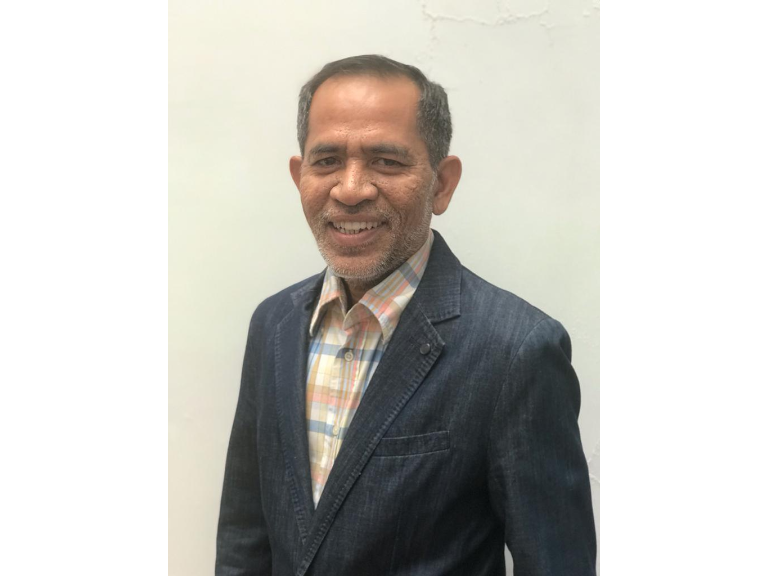
Preface From the First Author
“Nun. By the Pen (Al-Qalam) and what they inscribe” [Al-Qalam:1]
My journey into the Quran and Islamic knowledge started way back during the university days through the self-learning of Arabic while I was doing my first degree in Statistics and Actuarial Science. I was engaged with data and numbers, statistics and modeling, and applications in risk studies, economics, and finance during my student years until the Ph.D. Today, the field that I was engaged in is called “Applied Data Science”. The term data science was nonexistent then. During those days, I took the study of Al-Quran and Islamic knowledge as a private passion. Applying knowledge to Islamic finance was my main preoccupation.
What struck me then was how easy it was to learn Arabic, particularly if the interest is Classical Arabic or Quranic Arabic. Arabic is an extremely structured language; once you grasp the structure, the rest is just about acquiring more vocabulary and meaning or contexts. I relied heavily on the texts available then, namely the abridged version of Tafseer Ibnu Kathir, which came in three volumes, and Hans-Wehr Arabic-English dictionary. Within a short time, I can read most of the Classical Arabic texts with little problem. However, despite all of the effort, whatever I do is only to benefit my knowledge and enrichment. I know that to be well versed as a scholar in the field is way beyond my reach, and I was deeply engaged in my professional works at all times.
My data science journey continued as I discovered the R programming language in its early days in 2001 when I worked on economic data. What strikes me was many functionalities of R are similar to what I was working with at the University of Iowa, namely the Minitab statistical program and the Wolfram Mathematica. Moreover, to a large degree, R has similarities to the C++ program, the primary programming language I was using for my doctorate research work.
From 2010 onwards, I saw the rise of Machine Learning and Artificial Intelligence as a new field. I then took a deep dive into ML and AI algorithms, which took me to various fields of Statistical Learning, Machine Learning, Neural Networks, Deep Learning, and finally into Graph Theory and Network Science. In this journey, I refresh myself back into several prime areas in my doctorate days, namely in Game Theory, Behavioral Economics, and Systems Theory. Over the last decade, my occupation is in Data Science, and apply them within market applications under Data Analytics and Artificial Intelligence. While doing all of these, Data Science and Artificial Intelligence applications on Islamic knowledge have always been my penultimate target.
Usage of modern tools to uncover or rediscover the Truth is an apparent necessity. We may not be able to produce a new Imam Al-Shafi’e or Imam Al-Bukhari, but we may be able to replicate some of what they have accomplished. However, this is possible (at least for now) by relooking the Islamic sciences using new lenses. These new lenses are what we are starting to do here. Namely, to start a new work on Islamic Knowledge Analytics, beginning with Quran Analytics. I start this with the verse “Nun. By the Pen (Al-Qalam) what they inscribe”.
As in anything else, the starting point is the hardest; and I know that I cannot do it alone. It must be based on many people’s collaborative network, from many domains of expertise, regardless of their creed or belief, as long as the Truth is what he/she is after. I thank Dr. Azman Hussin, my co-author, for joining me in this work. His encouragement is extremely appreciated.
I welcome you on board this journey. The reward is from the owner of the Truth when you meet Him.