Preface From the Second Author
“The best of you are those who learn the Quran and teach it.”
There is no other motivation that drives this humble work except the above saying of Prophet Muhammad (SAW). It is an honor to give an added dimension to “learning” the Quran through data analytics. It is also proof of the eternal relevance of the Quran as a book of knowledge in that using new tools like text analytics reveals new knowledge and understanding about the Quran. The second part of the above saying motivated us to document our work and make it freely available in digital form. In keeping with the tradition of the prestigious scholars of the Quran, we humbly present our work as a gift to the world, particularly the “data generation”. We sincerely hope others will improve upon this work.
We formally started our #qurananalytics project to accompany our #learnbydoing approach to #networkscience by defining some objectives and methods.1 The main trigger was when we came across a well prepared dataset of the Holy Quran which was quite recently published. The obvious idea came to apply the current tools and methods in text analysis with the Quran datasets. In research, different methods used on the same data often yield different results. So, we thought that using the new methods and tools of #datascience, #textanalytics, and #networkscience to “learn the Quran” should be interesting. The Quran is also a subject matter that we have some knowledge of since both of us have a working knowledge of written Arabic and continue to deepen and broaden our own understanding of the Quran. It seems an ideal combination to build knowledge of the tools while applying them to a familiar subject matter.
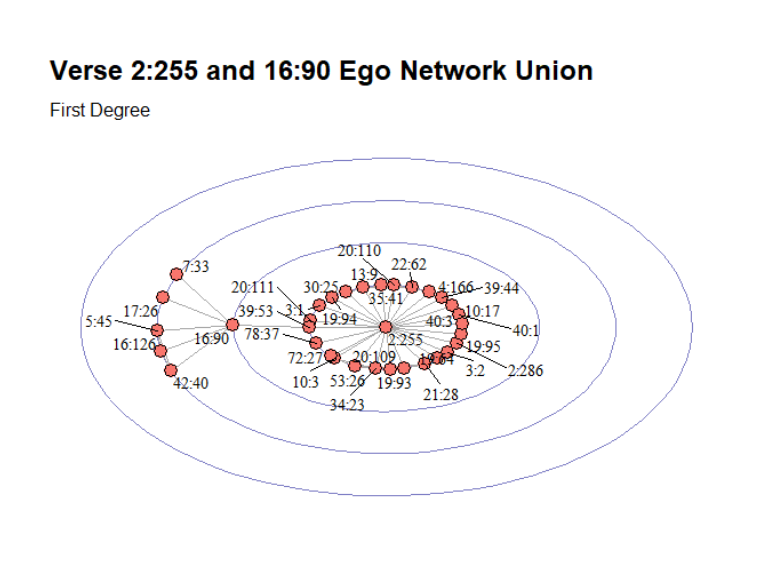
Later, the learning and encouraging feedback we got from the blog postings led us to further explore the application of these tools on the classical works of Tafseer, the interpretation of the Quran. We had some ideas how #networkscience tools can help us visualize the classical method of Tafseer al-Quran bi al-Quran (Interpretation of the Quran with the Quran). It is considered the best method to interpret the verses of the Quran. We showed some features of network graphs that enable us to visualize aspects of the Tafseer that are almost impossible to do manually and difficult to do without a network graph model. We discuss this in Chapter 9 of this book where we present our preliminary findings using network analysis applied to the best of the classical works of Tafseer, Tafseer Ibnu Katheer. Simple network concepts like “in-degrees”, “out-degrees” and “ego networks” proved valuable in analyzing Tafseer Ibnu Katheer.
Along the way, we also developed some customized tutorials on the tools that we used. These tutorials cover selected individual Surahs (Chapters) of the Quran like Surah Yusuf, Surah Taa Haa, and Surah Al-Kahfi - all of which are covered in different Chapters of the book. We hope our readers can learn the tools within the subject of “learning the Quran”.
In the initial project brief2, we wrote under the “Objectives” section,
We hope that this work will result in a book or manual on how to do Quran Analytics.
Alhamdulillah, the hope became a reality. I sincerely thank my co-author, Dr. Wan Hasni, for introducing me to #networkscience and lending me the many books he had on the subject. He painstakingly corrected and converted the R Markdown files I passed to him to be part of the contents of the book. I also would like to thank the reviewers for their valuable comments.
This book is designed as an introductory manual on #qurananalytics using R. It includes customized tutorials on the tools we used, sample codes, data wrangling techniques, and analysis of the results. This will help others interested in the subject to pick up the related skills and knowledge, comment on the findings, and to develop it further. In the final chapter, we included a “to-do” list that interested readers can further explore.
We can only express our sincere gratitude to our Lord and Creator for giving us this honor to add a drop in the ocean of knowledge related to His Book. Our salutations to the beloved Prophet Muhammad (SAW) whose saying motivated us in this work. We pray that our readers benefit from this humble gift and continue adding value to the chain of the Quranic knowledge.
“And our Lord is the Beneficent Allah, Whose help is sought” [Quran, 21:112]
Introduction to Quran Analytics, https://www.linkedin.com/pulse/introduction-quran-analytics-azman-hussin↩︎
Introduction to Quran Analytics, https://www.linkedin.com/pulse/introduction-quran-analytics-azman-hussin↩︎